
CRE operations / applied AI / innovation

Nik Mirando

Perpetual tinkerer and builder. I like understanding why things work, finding where they do not, and making the pieces work better together.

I build AI agents, products, automations, and data systems for messy, real-world work.

Headshot of Nik Mirando
Boynton Beach, FL
VP of Innovation · Sentinel Net LeaseCRE sustainability → portfolio data → operating systems

How the work connects.

Operating platforms, AI assistants, market intelligence, and building performance. A collection of working systems and experiments built around the way real estate actually operates.

Brokerage OS / Connected business operations

A brokerage rebuilt around one operating record.

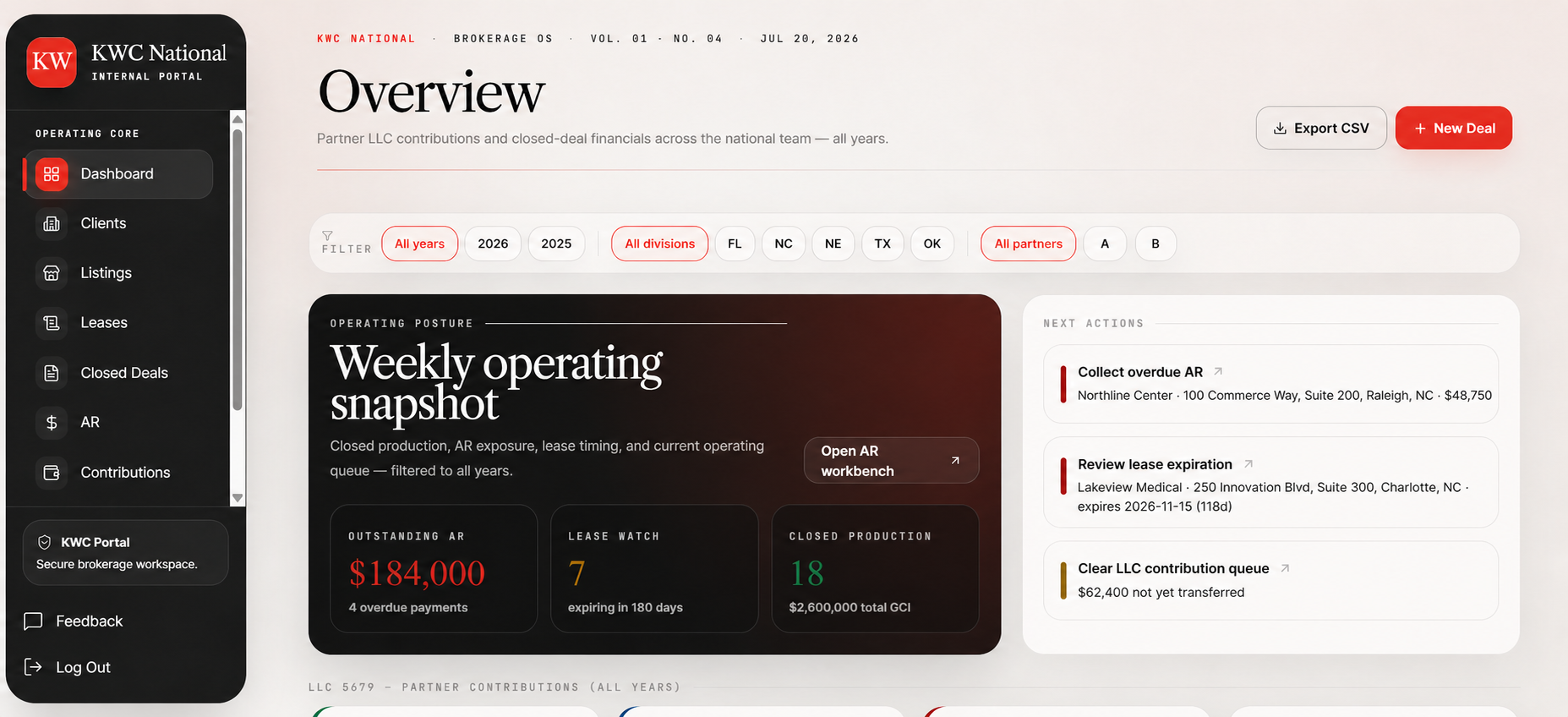
For a 20+ broker, multi-state team, I connected deals, listings, commissions, receivables, CRM, content, and documents around one operating record. A reviewed deal now carries through to the work that follows it—rather than being entered again in another system.

20+Brokers supported
635+Historical deals migrated
~$1K/moSocial generation saved
~4 hrs/wkInvoicing + transaction admin saved
brokerage-demo.rootwurx.com PUBLIC SAMPLE DATA
KWC National / authenticated team workspace SYNTHETIC RECORDS
KWC National Brokerage OS overview with synthetic financial, production, lease, and action-queue data Open Brokerage OS demo
CANONICAL RECORD Deals, leases, commissions, AR
OPERATING QUEUE Review states and next actions
DOWNSTREAM CRM, content, maps, and alerts
How it works

The portal writes the source of truth.

More than 635 historical deal records were cleaned and migrated before the old form was retired. Authenticated users now create or review records in Next.js; Zod validation and server actions write canonical deals, listings, commissions, payments, documents, and provenance into Supabase Postgres. FastAPI owns longer integrations and scheduled work.

Deal packets and leases become reviewable records.

Closed-deal packets become candidate transaction, commission, and payment rows. For listings, the service reads the Drive folder, OM, photos, and marketing material, then builds the exact required Crexi and CoStar field sets plus Canva flyer inputs. Financial calculations remain deterministic; missing required fields keep creation locked until a person resolves them.

In a separate brokerage deployment, an AI lease intake accepts up to eight executed leases, amendments, commission agreements, deal sheets, and invoices. Native PDFs and DOCX files are read first; scanned pages can fall back to bounded OCR. The draft covers 36 lease, rent, option, notice, allowance, commission, split, and invoice fields with field-level confidence and source context.

The model proposes; a person resolves and applies.

Missing values stay null, conditional dates remain conditional, and conflicting documents are shown instead of silently reconciled. A reviewer compares extracted and confirmed values before one idempotent, version-checked database function updates the existing deal, lease, commission, broker splits, field provenance, document links, and reminder rows. It cannot alter the closed stage or date, listing status, or settled payments.

Event chains stay reviewable and non-blocking.

  • Closed-deal saves can trigger a branded Canva graphic, Instagram caption, LinkedIn post, Slack approval packet, celebration, and Proxi map; downstream failures never roll back the canonical deal.
  • Reviewed listings generate a Canva flyer, grounded Instagram and LinkedIn caption, Slack delivery packet, and a Supabase export audit row.
  • Instantly webhooks and the Sunday sweep classify reply intent and direct-phone evidence before conservative FUB enrichment and warm-lead Slack notification.
  • A reusable GrowthZone adapter crawls multiple regional Chamber of Commerce calendars nightly, collapses duplicate events by title and Eastern date, and posts the next seven days to Slack each Monday.
  • Monday market-presence generation, monthly Crexi/CoStar market-export ingestion, a 15-minute Drive ingestion queue, and automatic lease/LOI term extraction feed distinct reviewed surfaces.
Portal or files

Forms, workbooks, packets, OMs, leases, images.

Typed boundary

Zod, parsers, AI extraction, and review flags.

Supabase

Canonical rows, source artifacts, and provenance.

FastAPI jobs

CRM, content, maps, reminders, crawlers, alerts.

Audit state

Run status, changelog, review state, and failures.

Public case-study figures: 20+ brokers, 635+ historical deals migrated, and roughly $1,000 per month removed from social generation costs. The team also reports roughly four hours per week saved on invoicing and back-office transaction administration. The portal shown above contains synthetic data, not client records.
Slack operating agent / Questions, knowledge & recurring work

The business can answer back.

An operating assistant inside Slack that answers questions across company records, CRM, documents, and shared knowledge. It investigates, remembers reviewed working methods, and turns recurring questions into scheduled updates.

ConnectedCompany records & documents
PersistentReviewed working context
RecurringScheduled questions & updates
TraceableSources and tool activity
SAMPLE FIRM / #operations / synthetic scenario CONNECTED WORKSPACE
# operations
AM
Operations lead9:14 AM

@Agent what are our top three sources for closed transactions this year? Rank by transaction count, not deal volume. Bucket every referral variant together and remember that rule.

A
Operations Agent9:14 AM

I counted 57 synthetic closed transactions. The raw values split referrals across three labels, so I normalized the accepted aliases and reran the count: Referral, 11 (19.3%); Cold call, 8 (14.0%); Networking event, 7 (12.3%). I saved that bucketing method as a workspace skill for future analyses.

Public-safe reconstruction / names and values changed
How it works

The model plans; the service owns the loop.

A Python 3.11 Slack Bolt Socket Mode service sends Claude 27 JSON-schema tool contracts spanning Supabase, Follow Up Boss, Notion, Drive, semantic document retrieval, reviewed Slack memory, skills, and saved queries. The service owns the hard eight-call budget, timeout, retry, within-run cache, result caps, and final response.

Learning is a scoped, inspectable write.

Reusable methods are upserted to jarvis_skills by workspace and unique name, with a description, full body, and one of five validated categories. Descriptions preload into the prompt; full bodies load only through skill_read. The follow-up learning pass skips short questions, short answers, and zero-tool conversations.

Durable state still has boundaries.

Slack-derived guidance enters retrieval only after a JSON review artifact is approved. Saved questions retain the original prompt, channel, cron, timezone, and optional read-only condition. Database access is protected by a SELECT guard, dedicated read-only Postgres role, transaction mode, statement timeout, and row caps; every run writes one accumulated audit record.

Slack thread

User, channel, workspace, and prior tool context.

Claude planner

Selects bounded tools inside the call budget.

Adapters

DB, CRM, Notion, Drive, corpus, memory, scheduler.

Grounded answer

Tool results and source references return to Slack.

Audit record

Question, tool trace, latency, outcome, and errors.

Verified against the current tool registry and test suite on July 19, 2026: 27 registered tools and 87 passing focused tests. The public demo uses synthetic names and records.
Acquisitions / Connected intelligence & execution

From the first email
to a decision-ready pipeline.

A connected acquisitions workflow that reads the opportunity, reviews its documents, prepares indicative underwriting, researches the tenant, and keeps the pipeline current as new information arrives.

Built for the handoffs as much as the analysis. Investment decisions stay with the team.

Intake & screeningEmail, attachments, linked documents
Deal intelligenceOffering review, risks, source evidence
Indicative underwritingCash flows, debt, returns, sensitivities
Tenant researchPublic evidence and information gaps
Pipeline upkeepStatus, priority, owner, next action
Team coordinationRequest drafts, follow-ups, weekly view
EXPLORE THE WORKFLOWILLUSTRATIVE EXAMPLES · SYNTHETIC DATA

Start with the email.
Connect the rest.

Identify the offering, gather attached and linked materials, and organize the opportunity around a persistent deal record. Apply screening criteria to what is actually stated; keep missing facts visible.

  • Email text, images, and attachments
  • Offering documents and deal-folder links
  • Duplicate detection and access issues
  • Screening outcome, priority, and next step
CEDAR INDUSTRIALIntake complete
Property
Single-tenant industrial
Asking price
$12,000,000 · stated
Offering memorandum
Located and linked
Missing information
Tenant financials
Next step
Review the document package

One synthetic opportunity followed through the workflow.

A connected deal brief, written review, indicative Bid Case, evidence links, actionable information gaps, and a pipeline that reflects the latest work.

Operational TEST pilot. The walkthrough uses synthetic examples; broker communications remain drafts.

Asset operations / Document-driven records

A closing package is
an operating starting point.

Leases and loan documents contain the rent steps, deadlines, covenants, and reporting requirements a team needs after closing. This system turns those documents into connected records—and routes the differences to the people who know them.

Production release documented · scheduled daily intake held

DOCUMENT → REVIEW → OPERATING RECORDSYNTHETIC DATA

One change.
Several consequences.

“The term is extended through June 30, 2034. Annual base rent shall increase to $840,000.”

Illustrative document excerpt

REVIEW QUEUENeeds owner review
Lease expiration
Jun 30, 2034
Annual base rent
$840,000
Source
First Amendment · §2

Document-backed. Awaiting confirmation.

CONNECTED VIEWSRent scheduleLease expirationsPortfolio reporting
What changes behind the scenes?

Versioned asset, lease, and loan records feed shared reporting views. Extracted facts, confirmed values, and unresolved conflicts retain different states. Owner review is part of the workflow. The documented production release does not mean the daily document intake has been activated.

Lease intelligence / Answers with evidence

The answer is only useful
if you can find its source.

Connect the executed lease and its amendments. Ask about obligations and terms. Get an answer that keeps the supporting language visible, with structured terms for portfolio questions and clause retrieval for “what does it say?”

Production release documented · source and quote checks built in

LEASE Q&A / SAMPLE ANSWERSSYNTHETIC LEASE

The tenant handles roof repairs.

“Tenant shall maintain and repair the roof during the Term.”
Sample Base Lease · §8.2

An answer with the language behind it, rather than a conclusion detached from its source.

How evidence stays attached

Lease chains connect base documents and amendments. The implementation checks quoted text against stored source pages, checks numerical support, and distinguishes confirmed records from document values that have not been checked. Missing or ambiguous evidence remains visible.

CRE public-data tools / Market & property intelligence

Public data, ready for real estate questions.

A set of open-source tools that brings current economic, demographic, employment, housing, and flood information into real estate research. Ask a question about a market or property and connect the answer to the relevant public sources.

EconomyRates, inflation & capital markets
MarketsPopulation, jobs & housing
PropertyLocation & flood information
Public sourcesCurrent data with clear gaps
CRE MARKET MCP / QUESTION SURFACE LIVE PUBLIC DATA
CAPITAL MARKETS

“Give me a capital-markets snapshot with SOFR, Treasury yields, mortgage rates, and inflation.”

LABOR DEMAND

“How are office-using and industrial employment trending in the Dallas–Fort Worth metro?”

TENANT BASE

“What does the business and tenant base around 4000 Westchase Boulevard look like?”

PROPERTY CONTEXT

“For this address, show tract demographics, HUD rent benchmarks, and whether FEMA maps it inside an SFHA.”

FREDRates, inflation, capital markets
BLSMetro employment and unemployment
CBPIndustry and establishment counts
CENSUSPopulation, income, housing, tenure
FEMAFlood zone, SFHA, mapped status
HUDFair market rents and income limits

The bundled server selects across these source contracts; each source-specific server can also be released and run independently.

How it works Tool surface, data correctness, packaging, and verification

Source contracts stay useful on their own.

FRED exposes six tools, Census/ACS four, FEMA two, HUD six, BLS seven, and County Business Patterns five. A separate CRE market server composes eight high-frequency workflows such as a capital-markets snapshot, metro employment, address-level unemployment, tenant-base analysis, and industry counts.

An address becomes the geography each source needs.

Shared geocoding resolves coordinates, state, county, tract, and metro identifiers before selecting the matching source tool. Returned payloads retain geography labels and vintage dates so an agent can state exactly what it used.

Missing, suppressed, and unmapped are distinct states.

FRED and ACS sentinels normalize to null. Suppressed CBP employment or payroll is never converted to zero. FEMA distinguishes an unmapped response from low flood risk and converts invalid base-flood elevations to null.

Packages are independent; smoke checks are semantic.

Each source server vendors its HTTP, environment, geocoding, error, and sentinel helpers, so it can leave the monorepo without sibling imports. Live smoke tests check returned values, geography, and payload structure rather than treating any HTTP 200 as success.

The 30 count covers source-specific contracts. The bundled market server composes overlapping capabilities into eight higher-level tools; those are not presented as 38 unique data functions.

The building is still
where it starts.

My background in CRE sustainability shapes how I approach the broader work: understand the physical asset, connect the evidence, and turn information into an operating decision. These projects remain part of that work.

Baseline / Building performance diligence

Building diligence with the math exposed.

A building-performance diligence tool that connects a property assessment, utility history, and asset information to energy, emissions, water, and improvement opportunities. The inputs and assumptions remain visible alongside the modeled results.

3Required source inputs
ASHRAE 211Audit procedure
DOE + CBECSEnergy benchmarks
EPA eGRIDScope 2 factors
BASELINE / ESG DUE DILIGENCE ENGINE SYNTHETIC VALIDATION CASE
ASHRAE / DOE / CBECS / EPA eGRID

214,796 SF multifamily / Climate Zone 4A

Screening outputs, not field observations. Every value below is reproduced in the public methodology case.

42.6 SITE EUI kBtu / SF / yr
581.6 BASELINE GHG tCO2e / yr
$88.4K YR 1 NET SAVINGS all modeled ECMs
251.6 GHG SAVINGS tCO2e / yr
MEASURENET COSTENERGY / YRGHG / YRPAYBACKROI
Rooftop solar$425,934890,630 kBtu75.4 t9.1 yr11.0%
DHW heat pump$0 after incentive2.31M kBtu116.5 t——
LED lighting$0 after incentive167,756 kBtu14.2 t——
Condensing boiler$112,060335,511 kBtu17.8 t27.8 yr3.6%
6 applicable ECMs / 11 suppressed pending delta data Policy fines withheld until current ESPM mapping is revalidated
How it works

Actual utilities anchor the archetype.

Property type, ASHRAE climate zone, construction vintage, and size select a DOE Commercial Prototype Building archetype. CBECS and ENERGY STAR property-type benchmarks validate the starting EUI; twelve months of actual utility data then calibrate the fuel-specific baseline before any conservation measure is evaluated.

Interpretation and arithmetic have different jobs.

Claude extracts systems and utility records from source documents. Python owns measure applicability and DOE prototype deltas, EPA eGRID location-based Scope 2, combustion-based Scope 1, water and DHW linkage, capital cost, incentives, payback, IRR, NPV, and building performance standard exposure.

Unknown stays unknown.

Every output is labeled observed, calibrated, modeled, or unavailable. The public case uses synthetic property inputs. Jurisdiction exposure appears only when the policy table and asset applicability are current; unsupported costs, incentives, and savings stay withheld instead of becoming polished but ungrounded certainty.

ESG Almanac / Sustainability reporting & evidence

Framework answers. Firm evidence. Separate boundaries.

A GRESB advisor that connects sustainability reporting questions to framework guidance. A deeper prototype brings together firm evidence, asset data, benchmarks, and scenario analysis while keeping private company information separate from shared reference material.

Framework guidanceAnswers with reference context
Firm evidencePrivate information kept separate
ScenariosAsset-level reporting implications
BenchmarksContext for portfolio performance
ESG ALMANAC / SCENARIO ANALYSIS SYNTHETIC PORTFOLIO

What changes if Northline Tower earns LEED O+M?

Model the directional GRESB impact. Use ownership-adjusted floor area and compare the result with the supplied prior-year peer average.
Current coverage 41.8%
After certification 55.6%
Prior peer average 48.0%
Positive directional impact for BC1.2. LEED O+M is an operational certification reported under BC1.2. Adding the asset's 312,000 ownership-adjusted square feet raises synthetic portfolio coverage by 13.8 percentage points and moves it above the supplied peer average. That should improve performance against the benchmark; the final point change still depends on the full peer group and GRESB's non-public certification weighting. GRESB BC1.2 + ownership-adjusted firm asset rollup
How it works

Indicator lookup, keywords, then vectors.

Direct indicator-code matches and yearly-change guidance are checked before keyword and pgvector semantic retrieval. Public framework and firm-only searches run separately, then merge with source labels and firm evidence first. Empty context produces an explicit gap, never a synthetic answer.

Shared knowledge is explicitly null-firm data.

Public queries require firm_id IS NULL. Firm retrieval calls a dedicated RPC constrained to the allowed firm ID. The Teams adapter maps a Microsoft tenant to one firm before retrieval. Unknown IDs fail before the database search.

The math changes with the indicator.

EN1 data coverage is floor-area-weighted by ownership share, never asset count. ASHRAE Standard 100:2024 EUI thresholds can deterministically select the Energy Efficiency pathway. LEED O+M changes operational certification coverage under BC1.2. The engine reports the directional benchmark impact and supplied peer average, but reserves an exact point gain because certification scoring also depends on the full peer group and non-public weighting for validation, age, property subtype, and country. Requested scenario files are generated as four-sheet workbooks in code.

The firm layer uses a synthetic 30-asset portfolio and 112 firm-scoped chunks. The generic REST adapter still needs one-key-to-one-firm binding before production multi-tenant use; the Teams tenant mapping already enforces that boundary.
ENERGY STAR connection / Portfolio performance

Portfolio data, available in plain language.

A private connection between an AI assistant and EPA ENERGY STAR Portfolio Manager. Ask about property scores, energy use, and emissions in plain language, using the portfolio’s actual EPA records.

EPA dataOfficial portfolio records
LocalRuns on your computer
MetricsScores, energy & emissions
Open sourceInspectable implementation
CLAUDE DESKTOP / LOCAL MCP NO HOSTED MIDDLEMAN
> Which properties have an ENERGY STAR score below 50?
[tool] list_properties
[tool] get_property_metrics x portfolio
> Three properties are below 50. I ranked them by score and included site EUI so you can separate score from energy intensity.
list_propertiesIDs
get_property_metricsscore / EUI / GHG
get_group_score_summarygroup rollup
get_portfolio_summaryportfolio rollup
How it works

Credentials stay on the user's machine.

The stdio MCP process reads local environment variables and sends credentials only to the official ESPM endpoint. There is no application backend, telemetry service, or project database.

Discover names before requesting values.

Portfolio Manager exposes XML and metric names that can change by report. The server discovers available metrics, requests the correct reporting year, then normalizes results into stable JSON contracts for the model.

Illustrative answers remain illustrative.

The repository documents working test and live account paths but does not currently ship an automated test suite. Public portfolio responses demonstrate the interface, not a claim about a real user's property count.

More ways to make the work flow.

Supporting work across company knowledge, document processing, and lead response.

Company knowledge, kept current.

Keep a private document library current as files change, and answer questions with references back to the original source.

From documents to usable records.

Turn rent rolls and operating statements into reviewable records, flag mismatches, and produce consistent documents from structured information.

Lead response after consent.

A lead-response and qualification system that respects consent, interprets project photos, and checks real calendar availability before booking.

Better systems start
with the actual work.

I’m interested in where real estate operations, AI, and building performance meet—and what it takes to move from an interesting prototype to something people can rely on.

Compare notes on LinkedIn

That same instinct carries beyond software. Chances are you can find me adding to my garden, renovating part of my home, or tinkering with a project car or boat.